'Surviving A Nuclear Disaster!' YT Interview (12/20/2013) ~ 'Campaign:1950s NUKE SURIVAL SKILLS NEEDED NOW' WND (7/20/2014) |
|
Bomb & Fallout Shelters Plans & Nuclear Civil Defense FAQ - Part 3
For Surviving Nuclear Bomb Blast and Radiation Threats with FREE bomb shelter and fallout shelter plans, guides & ready made fallout shelter sources! UPDATED 7/15/2014 |
 |
The Good News About Nuclear Destruction!
...and then our popular & essential family guide for...
What To Do If A Nuclear Disaster Is Imminent!
...and our latest detailing protection from overseas fallout...
When An ill Wind Blows From Afar! (Like From Japan Fukushima Nuclear Crisis)
We've been promoting Nuclear Civil Defense Training of the public for well over a decade! CLICK TO ORDER KI & RAD DETECTION HERE!If you do nothing else here, read our myth-busting expose...
See where our proposal was voted & ranked #1 a year before Fukushima, here at...
|
*** If Nuclear Bomb Crisis Imminent READ THIS NOW! ***
What is the Purpose of This FAQ?
Who Needs a Nuclear Bomb Shelter Strategy?
What are the Nuclear Bomb Blast and Thermal Pulse Effects?
What are the Nuclear Bomb Radiation and Fallout Effects?
What's the Difference Between Alpha, Beta and Gamma Radiation?
What's the Difference Between Roentgen, Rad and Rem Radiation Measurements?
How Much Radiation Is Too Much?
Do I Need A Radiation Detector?
How radioactive fallout affects different food production sources...
What Areas are Likely Targets?
What's Required for Nuclear Bomb Sheltering?
What Plans or Ready-Made Bomb & Fallout Shelters are Available?
In Summary...
ADDITIONAL RELATED RESOURCES...
Q: What areas are likely targets?A: What constitutes a likely nuclear bomb target here in the U.S.A. varies on what you perceive the most probable nuke bomb threats to be in your lifetime. Terrorists eager to cause the greatest mayhem and panic to the greatest number of people? Or, Russia and/or China directly or via surrogates, or rogue nations, launching a surprise nuke bomb attack on the U.S. mainland? For those who feel that that holds the greatest danger, you can check what FEMA used to think constituted a potential target for your particular state by clicking on your state name below. Be sure, though, to also read there Bruce Beach's 'UPDATE to Target Information!!!' that you'll see linked there below your state FEMA map that explains changes regarding base closings, etc., since these maps were first published in 1990. While these 25 year old FEMA maps assumed a full-out nuclear war attack from Russia and/or China, they are still instructive in illuminating how large cities and military installations are atop anyone's target lists, even if 'just' a terrorist with 'only' a single nuke was all that's in our future. As with determining the valuation of any real estate there are three factors that are most important in making the determination of where is safest: location, location, and location. So, too, with determining the risk level of your current residence and thus the level of protection required, its location is of primary concern. Dr. Art Robinson, Oregon Institute of Science and Medicine, Publisher of 'Nuclear War Survival Skills' book, Co-Author of the Civil Defense book 'Fighting Chance' (over 500,000 copies sold):
Bottom Line: Obviously, the safest places to reside will vary on the nature of the nuclear threats you perceive to have the highest probability of occurring in your lifetime. For a future nuclear bomb attack on mainland U.S.A., then all military targets are top on the list and most large cities would be secondary, with a few exceptions, like Washington, DC. But, for nuclear terrorist concerns, then the largest population centers would more likely be targets of first choice. In either case, the safest places would be most anywhere other than in or near or downwind of large cities, especially those immediately adjacent to or downwind of military targets. Also, even for the populations of cities that survived an attack, the basic needs of water, food, medical and law & order could make for a miserable and quickly deteriorating nightmare. Obviously, not everyone can move to live & work in a rural location, but most people won't be reading this and fewer still will heed it. But, for many still, simply living 20 miles away, and upwind, from target locations will be all the difference in the world when combined with some of the simple preparations from the knowledge presented here.
Q: What's Required for Nuclear Bomb Sheltering?A: For locations in or close to probable bomb targets, then protection from the bomb blast, fire and fallout would be required. For all other areas, more than 95% of the country, then only fallout need be of concern. Bomb blast and fire protection require hardened, usually below ground structures, but even simple expedient backyard earthen shelters providing 15 psi integrity are survivable as close as 2 miles from a 1 MT (1000 kilotons) surface bomb blast. These home built and also prefab ready-to-bury blast shelters, that would survive the blast even closer to ground zero, are detailed later below. For fallout protection, which will concern the greatest number of people, both those surviving within the bomb blast zone and the much larger numbers downwind, perhaps for hundreds of miles, there is some very good news amongst all this. Radioactive fallout is dangerous because it is giving off so much energy, but that also means it's quickly becoming less dangerous over time as it exhausts itself. In a very high fallout area close to ground zero, an hour after the explosion, that freshly arrived fallout could be, for example, 1000 R/hr and lethal to be exposed to it for as little as 30 minutes. But, in as few as 7 hours later it would only be 100 R/hr and in another 7 hours only 43 R/hr. From the Nuclear War Survival Skills book:
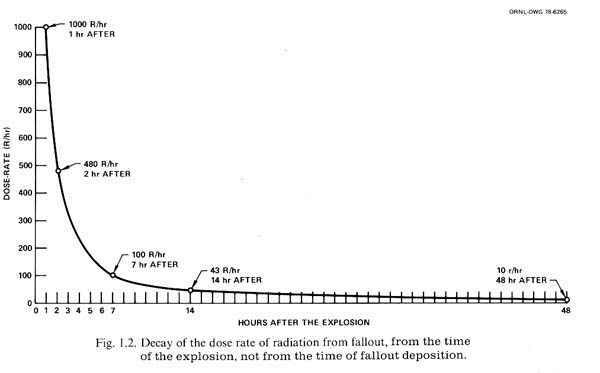
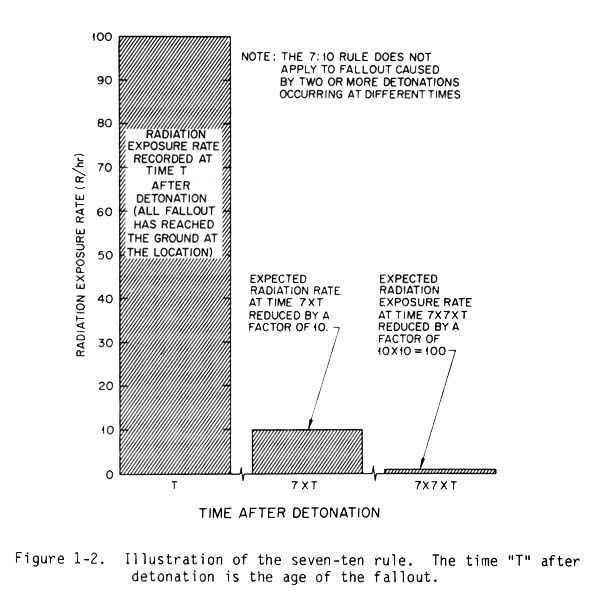
This degrading effect above, and also illustrated below, is called the "Seven-Ten Rule". For every seven times older the fallout becomes, it has also decayed to 1/10th of its strength. So, 90% of the gamma radiation is gone after the first 7 hours. Then, 90% of that remaining 10 percent is largely gone after two days. This is the 'good news' and why prompt sheltering is both effective and viable and should be seriously explored and embraced by all. The 7-10 Rule illustration below is from the FEMA handbook Radiation Safety In Shelters:
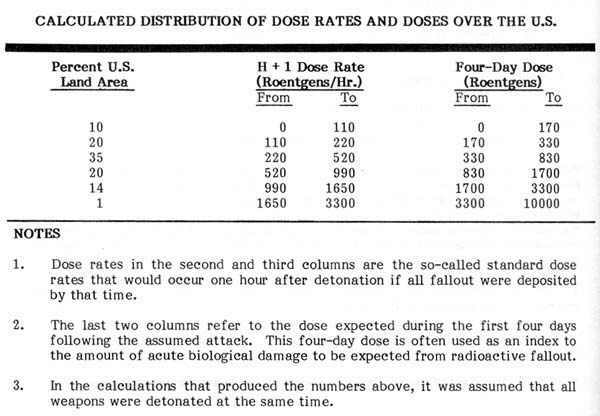
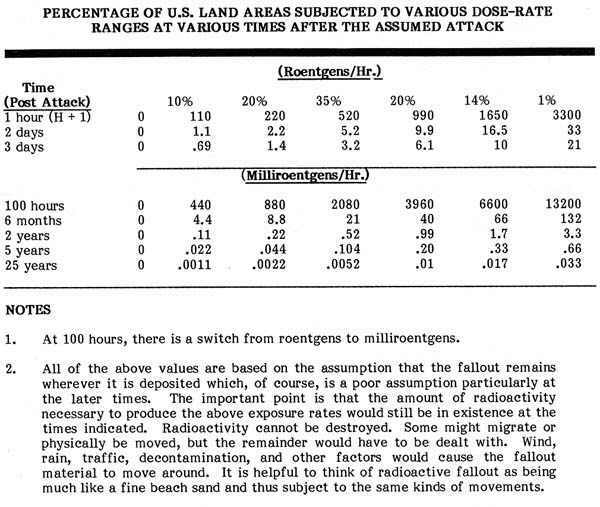
Even starting with a high, close to ground zero, fallout exposure rate of 1000 R/hr, within two to three days after an attack the occupants of most shelters there could be spending some time outside performing essential chores or attempting to acquire additional supplies, or just evacuate even further away, etc. For the majority of people even further downwind of ground zero the fallout has had even more time to decay before reaching those areas and also would be much more dispersed and thus the time required to be sheltered would be greatly reduced, too. (Exceptions, though, would be where rain showers had created 'hotspots' downwind or where multiple weapons had been used on important military targets.) The example above of the close to ground zero 1000 R/hr fallout requiring a couple days of sheltering will not apply to much of the landmass here in the U.S. further downwind that will see less intense radioactive fallout. The following two charts from the 1986 FEMA publication "Radiological Instruments: An Essential Resource for National Preparedness" brings together both the distribution and decay rates of fallout over the total land mass here in the U.S. likely to be affected. They are assuming here a worst case and very large nuclear attack upon the U.S.
Note that the above charts and decay rates applies only to fission and fusion bomb weapons and does not apply to the so-called "Dirty Bomb" or RDD (Radiological Dispersal Device). The reason it does not apply to an RDD bomb is that they are expected to be made up of only a couple of the common and more easily obtainable commercial isotopes (such as Cobalt-60 or Cesium-137 or nuclear power plant fuel rods) that all have relatively long half-lives. Fortunately, though, they will not have contaminated anywhere near as extensive an area as a fission or fusion nuclear bomb and effective prompt evacuation will be the more viable alternative to long-term sheltering. However, you might not be able to readily evacuate, especially with a mass exodus, and you may then be forced to shelter until you can more quickly evacuate later, and you do not know what exactly the nature of the future nuclear threats will be, so you need to still fully explore your sheltering options below. Protection from external radiation, primarily gamma radiation in fallout, is provided by three factors: Time: Effectively minimizing your exposure time while also 'waiting out' the natural decay of the fallout in a safe shelter. Distance: Effectively maximizing your distance from the fallout, as the inverse square law applies here to distance. (When you double the distance between you and the fallout, you have decreased its intensity by a factor of four.) Shielding: Effectively maximizing the amount of radiation absorbing material between you inside and the radiation source outside. As an example of the above, everyone is familiar with a hot stove and getting burnt by it when careless. Too close to the flame, for too long a time, without a protective glove and you get burned. Same basic principle applies with radiation sources; too close for too long without protective shielding and you will be acquiring a higher total dose than you would have otherwise. But, promptly getting your family into a prepared shelter as far removed from where the fallout is being deposited as possible and designed with good barrier/shielding qualities that permits you all to wait out the natural decay of the fallout, can be the difference between life & death. Regardless of how intense the radioactive fallout is in your specific area, the protective effectiveness of your shelter will be largely based upon its shielding from gamma radiation, the most penetrating and destructive radiation you'll have to contend with. (And, to a lessor degree on any distance you can put between the fallout deposition and yourself.) Just as body armor protects a person from bullets, so too does mass between you and the fallout protect you from its gamma radiation. The more mass the better, whether it is lead, earth, concrete, water, or stacks of books, etc. The amount of mass that'll absorb 1/2 of the gamma rays penetrating it is considered to have a Protective Factor (PF) of 2 as compared to an unprotected person in the open at the same location. If the mass is sufficient to stop 99% of the gamma radiation it would have a PF of 100 and if it stopped 99.9% it would be considered a PF of 1000 as it reduced the incoming radiation to only 1/1000th. The illustration below is from the FEMA handbook Radiation Safety In Shelters:
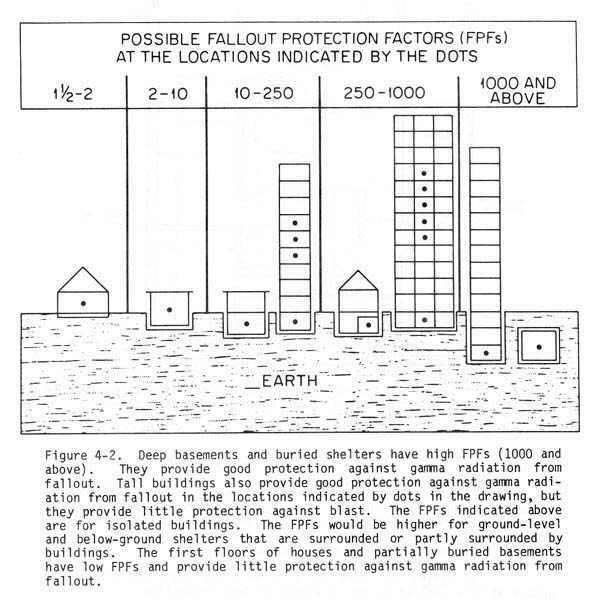
The bare minimum FEMA recommended PF to strive for is a PF40, which means that the mass was sufficient to reduce the incoming radiation to 1/40th of the dose you'd receive outside if unprotected. This would be barely sufficient protection in most all fallout areas requiring sheltering, and especially deficient for the heavier fallout nearer ground zero or in a rain out created hot spot downwind. It is considered woefully less than what's required by many experts. However, as you'll see below, it's too easy not to achieve PF's of 200, 300, or 400 or more and it would be prudent to do so. (Just 3.6 inches of packed earth reduces the gamma radiation penetration by half which means you have a PF of 2. With 18 inches you have a PF 32 and with 30 inches it's over PF 300 and with 3 feet of earth you are at about 1000 PF.) The higher PF's are worth striving for because, for example, in a high-risk fallout area that had a two week total dose of around 10,000 R, you would need at least a PF100 shelter just to stay near a 100 R dose being received by each of the occupants over the two weeks. Adding just another 3.6" of earth covering and thus doubling that PF to 200 would cut that total dose received by your family to only 50 R each. Clearly, with the unknowns of exact targeting, number of weapons committed to each, variable winds, rain out hotspots and perhaps even missiles off target, if you are going to build a fallout shelter at all, it needs to be with as high a practical PF as achievable. Here is a comparison of different thicknesses of earth and the protection factors afforded from the Nuclear War Survival Skills book:
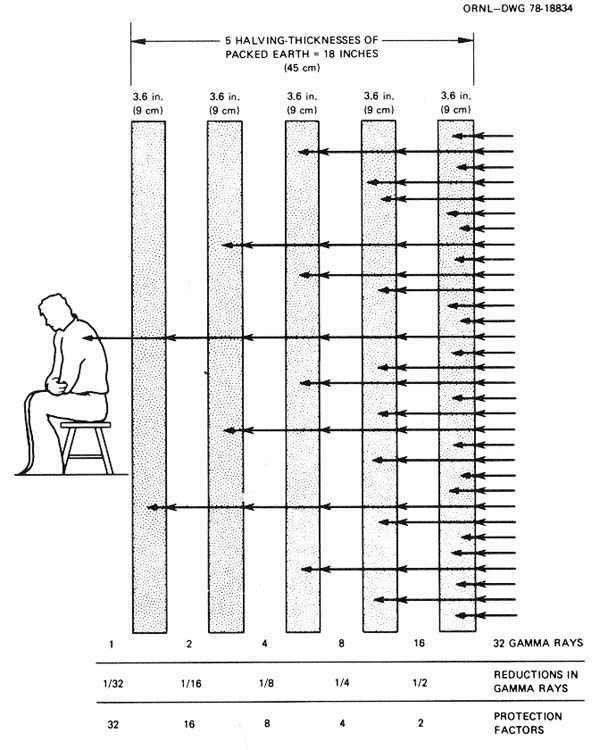
The denser and thicker the barrier substance, the better its shielding properties. Where every 3.6" of earth cuts the incoming gamma radiation in half, thus doubling the PF, it would only take 2.4" of concrete because it is even denser. Of course, earth is cheaper, but where concrete had been used in the construction of a shelter it'll be providing even additional barrier protection. Also, the tenth-value thickness, in inches, for steel is 3.3; for concrete, 11; for earth, 16; for water, 24; for wood, 38. That means that where you have those thicknesses you'll have only 1/10th as much gamma radiation pass through with that barrier material. Dr. Art Robinson, Oregon Institute of Science and Medicine, Publisher of 'Nuclear War Survival Skills' book, Co-Author of the Civil Defense book 'Fighting Chance' (over 500,000 copies sold):
Bottom Line: As mentioned above, with all the unknowns and variables involved with pre-determining the possible fallout your family will need to be protected from, it is prudent to not just pray and hope for the best, but to have also prepared for the worst. Earth is a cheap, plentiful and effective fallout barrier material that can be utilized with numerous different shelter designs, as seen below. 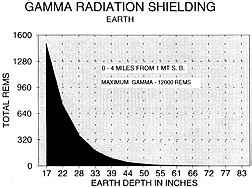
You'll need to decide which best fits into your family level of concern, your current housing situation and location and available budget. Below, most all American families will find something that'll easily improve their odds of surviving 100 fold or more.
A: There are expedient (last minute) shelter plans, home built buried shelter plans and FEMA shelter plans, both for remote retreats, backyards or basements. There are also both cheap and expensive ready-to-bury completed shelters and even large survival underground shelters.
Review them all, learn from them all, and then choose which option would best fit your own family needs and resources.
Expedient Sheltering: Here are included all those last-minute sheltering options, both if events have overtaken you to where you are only now feeling the need for acquiring it quickly and/or if your restricted funds require exploring the low-cost sheltering options. The best resource for inexpensive last-minute fallout sheltering plans are to be found in the 280 page book Nuclear War Survival Skills. Read or print it out free on-line at that link and/or a hard copy can be purchased here.
In it you'll discover not only the plans for numerous expedient shelters, but the principles behind all fallout shelters and many other essential aspects to sheltering and survival in nuclear fallout. Written by Cresson H. Kearney, the author of the original Oak Ridge National Laboratory edition. The Contents page of the new updated and expanded 2001 edition is below:
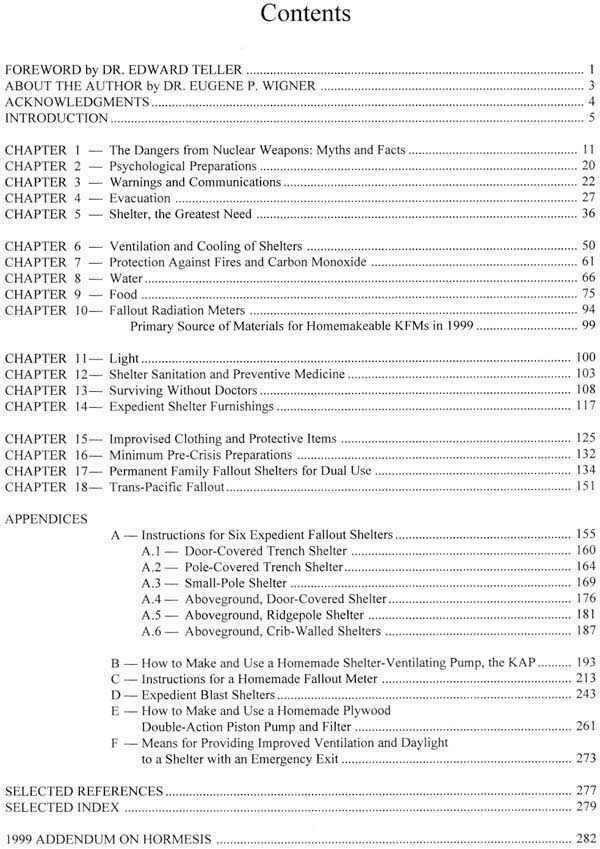
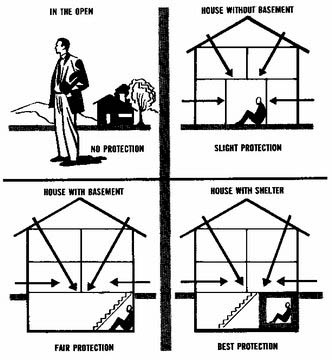
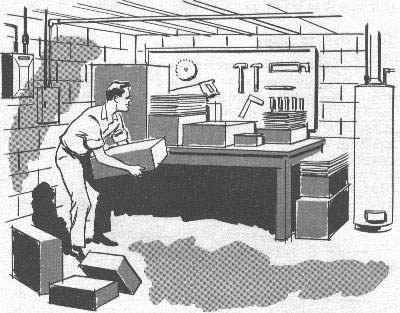
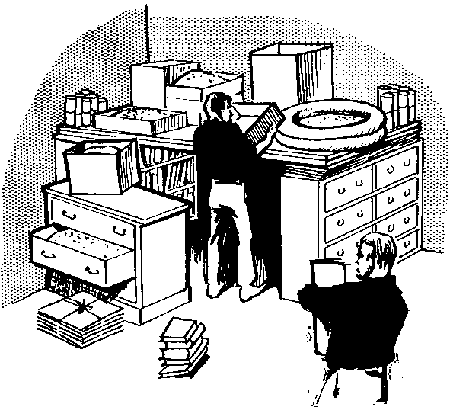
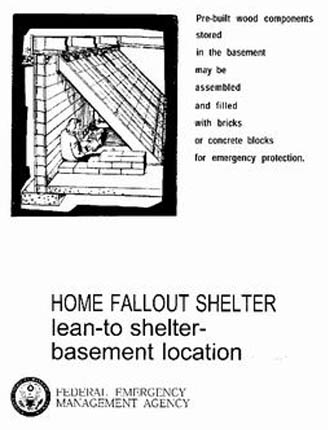
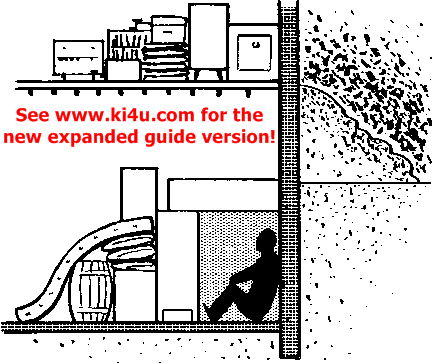
Home Expedient & Effective Sheltering Options You Could Do Very Quickly...While a fallout shelter can be built most anywhere, you need to see what your best options are at home or nearby locally. You want to maximize both the distance from where the fallout will likely be settling and the shielding material (mass) you already have there that could readily be incorporated to better surround and shield your fallout shelter. Some structures already provide significant shielding or partial shielding that can be enhanced for adequate protection. If you do not have a basement available, you can still use the techniques shown below in any above ground structure, but you'll need to use more mass to achieve the same level of shielding. You may consider using other solid structures nearby, especially those with below ground spaces, such as commercial buildings, schools, churches, below ground parking garages, large and long culverts, tunnels, etc.. Some of these may require permissions and/or the acquiring of additional materials to minimize any fallout drifting or blowing into them, if open ended. Buildings with a half-dozen or more floors, where there is not a concern of bomb blast damage and windows intact, may provide good radiation protection in the center of the middle floors. This is because of both the distance and the shielding the multiple floors provide from the fallout on the ground and roof. Bottom Line: choose a structure nearby with both the greatest mass and distance already in place between the outside, where the fallout would settle, and the shelter inside.
The majority of people requiring any sheltering at all will be many miles downwind, and they will not need to stay sheltered for weeks on end. In fact, most people will only need to stay sheltered full-time for a few days before they can start coming out briefly to attend to quick essential chores. Later, they can begin spending ever more time out of the shelter daily, only coming back in to sleep. As miserable as it might seem now, you and your family can easily endure that, especially compared to the alternative. And, it's really all too easy here to build a fallout shelter, and to do so very effectively, not to get it done...
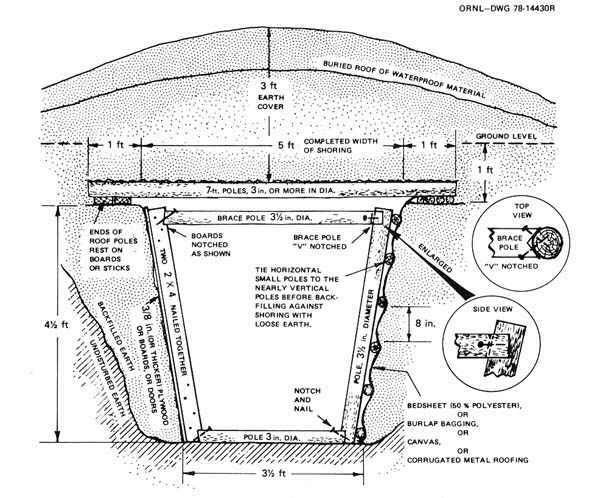
The above section is from our comprehensive, last-minute, FREE public guide... There's much more detail in that 10-page guide about the shelter, air filtration, provisioning, and afterwards enduring the expected disruption of local services. Or, If No Basement... You could do a combination tornado/fallout shelter in the backyard, if the ground isn't now frozen where you are. With 30" of earth covering alone you would achieve a PF of 300 and occupants would receive less than 1/300th of the gamma-ray dose of fallout radiation that they would otherwise have received out in the open. A fairly expedient (pretty cheap/fast) option for outside shelter building, especially for all those without basements, is to acquire a section of, under the road rated, corrugated culvert pipe of at least 4' diameter. It's very common, cheap, and you might even find some for next to nothing at your local metal junk yard that you could take home in the back of a long-bed pick-up (if 12' long or less) or on a boat trailer. Have a hole dug a foot deeper than half the diameter of the pipe in an area without a high water table that has good drainage. Put in a foot of gravel first for drainage. Roll it in and wall up the ends with cemented block, railroad ties, or even a couple sheets of stacked reinforced plywood a little longer than the diameter, but leaving you an entrance/exit and air shaft at both ends at the top half that's still above ground. (If you've got the expertise/welder or money, and time, you could go ahead and have 10 gauge steel bulkheads welded on each end instead.) Whatever you use, have these end walls extend up past and above the culvert for 2' - 3' for holding back the dirt at the ends you'll later put atop the shelter. You won't have enough excavation dirt (from the hole you created) to cover the shelter back over to a 2-3' level and still assure the grade atop is gradual enough to thwart future erosion, so you'll need to get some more from elsewhere in your yard or bring in some with pick-up truck loads, etc. You'll also need sandbags full or solid masonry blocks to pre-position them at one end to pull/lift/push into place when you all get inside. Have one end already stacked solid with them, except for a small air gap at top and have the other end sealed up, too, except for enough room to wiggle in for the largest member of your family. The reason we have created two potential entrances, with removable blocks or bags, is so we also have two potential exits, if part of your house or a tree later fell on one end. There's a lot of refinements that can make this more permanent, and better assure water doesn't get into the shelter before you do, etc. But, the point is, you can get creative with encasing mass all around your family for little time/money/effort. Some are even sliding those small portable utility buildings atop theirs, minus the floor, to both cover the 'hump', and have their 'comings and goings' less gopher like to prying eyes. It also, with gutters leading further away, lets them more easily rinse the roof of fallout later and have it then even further away and no longer up above their shelter down below. Some are even rigging up hoses with small pools to do it from inside the shelter remotely and earlier, via bilge pumps battery driven. Once you grasp the principles of fallout sheltering (distance, mass and time) and see what you have around to work with, you'll discover many creative ideas to maximize your family sheltering. A cheap and quick, last-minute, shelter may be cramped and miserable for a couple days, but remember that radioactive fallout will lose 99% of its lethal intensity in those first 48 hours! Anybody can put up with most anything for two days, when it's life or death! It'll likely be a treasured story of survival your family will be around for to recount for years ahead together, especially when compared to the alternative fate of being caught above ground and exposed to the full intensity of radioactive fallout in those most dangerous first couple days! One more shelter for those with no basement... Another cheap/fast last minute expedient fallout shelter that could be thrown together in your garage, or even in the center of a home, though spouse may not be thrilled; 4' X 4' X 4' pallet footprint sized cube per person, so if three people, then a single row of 12' long 4' wide, surrounded by minimum of 18" thick walls 4' high of stacked sacks of dry ready mix, dry cement or barite (that's inexpensive 100# sacks used as drilling fluid additive). Or, sand or dirt bags, if you can stack them. Then, timbers or fence posts, side by side, across top, then another 18" thick sacks atop that roof. Details on entrance, air circulation & filtration, etc., in WHAT TO DO IF A NUCLEAR DISASTER IS IMMINENT! A variation on this theme, that's even quicker to build and better structurally to assure roof supports can handle loads, is to have on hand a length of 4' diameter galvanized steel road culvert that you could roll into garage to then pile your sacks under the curve, up along the sides, atop and on both ends leaving a little opening for air flow on both ends, one high, the other low. You'll pull in last sacks behind you to seal up the entrance end. Again, more on the principles guiding details of air filtering, etc. at that linked report above. Figure minimum of three feet long for every person sheltering in the tube... 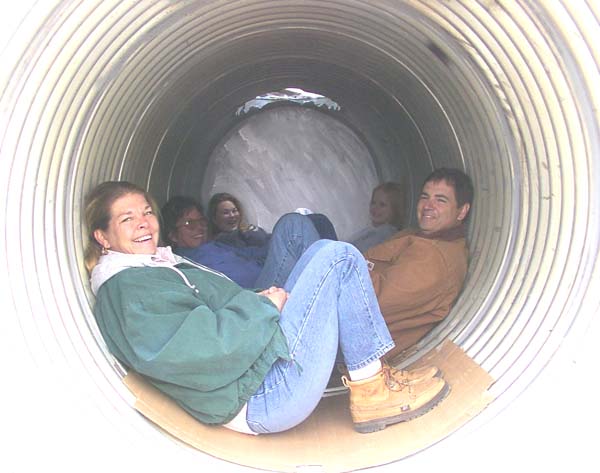
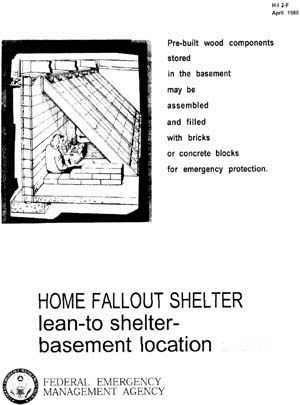
The mass of 18" is a minimum, you can certainly do thicker and should if possible, but even that 18", especially with the denser (heavier) mass, will cut radiation to 1/30th to 1/40th compared to no mass. If exposure to 600 rads is lethal with just an hour exposure, you'd be getting only 15 to 20 rads and if that 600 rads was the high for your area right after the explosion, it'll be only 60 rads outside in 7 hours and you'd be getting 1.5 - 2.0 per hour then. Anything < 100 rads total accumulated dose is 100% survivable, though of course, as little as possible is always best, but with the above shelter you'd be amongst the survivors and not the unfortunates that did not know any better how to easily minimize their dose in those crucial first 48 hours. And, if sacks of ready mix, cement or barite being used, think of them when you acquire, and pre position a stock of them for later shelter needs, as barter goods that will likely be even much more valuable afterwards. BTW, barite (barium sulphate), pound for pound, is actually much better than lead in attenuating (absorbing) gamma radiation of Cesium energies, which is the fallout benchmark. It's added to concrete in nuclear facilities to better harden those walls against radiation penetration, as well as the stuff you drink as a radiopaque medium used as a diagnostic aid in GI tract radiology. Anyways, once you understand the principles involved in radiation shielding, and the short time that it's required, you'll see many opportunities and resources around you to maximize your family safety, that while not perhaps super comfortable, are cheap, fast & fully effective for the brief time needed. FEMA Shelter Plans: For over 50 years the U.S. Federal Government has produced volumes of information and plans on fallout shelters and related topics. Some of the best material dates back to the 60's days of Duck & Cover drills. We also have all the plans, and tons of other civil defense and survival material, on our DVD here that we usually give away free as a bonus to customers there. Some of these are only PF 40's, so I'd look for opportunities to reinforce them to handle more mass to raise that higher.
Homebuilt Buried Tank Shelters:
#1
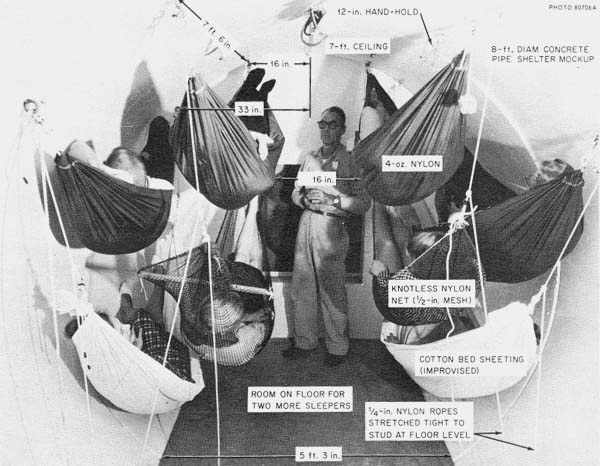
Engineering blueprint plans (6 drawings 24" X 36" with specifications for a variety of sizes and types) and a video were available from Oregon Institute of Science and Medicine. #2
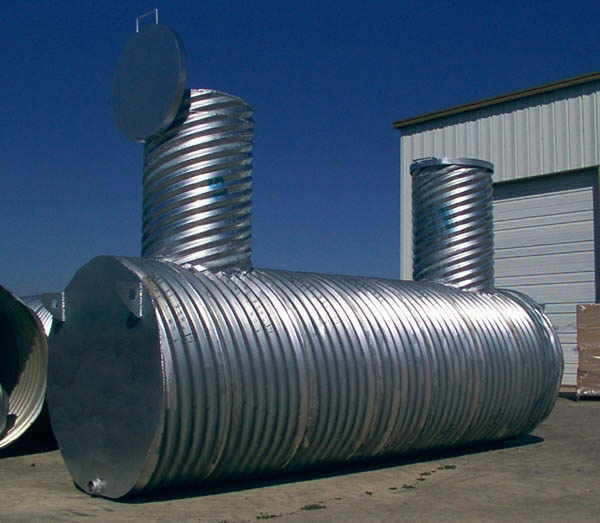
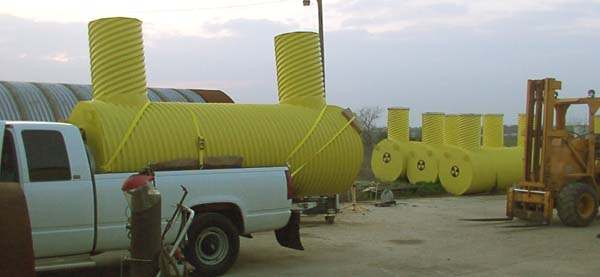
It's small and cramped at only a 4' diameter by 12' long, but for many locations it'll be endurable long enough for those most dangerous higher levels of fallout radiation in the first 24 hours. It's a great, and cheap, tornado shelter, too. Built by a local fabricator you could have it made for under $3,000, or much less if you could do the welding work yourself. Nuclear Survival Community Group Shelter: The best known, largest and most comprehensive group fallout shelter is the ARK II founded by Bruce Beach 90 miles NW of Toronto, Canada. Here 500 people from all over North America will make there way to this 42 buried bus self-sufficient community prepared to sustain their members for up to six months directly and support rebuilding beyond that.

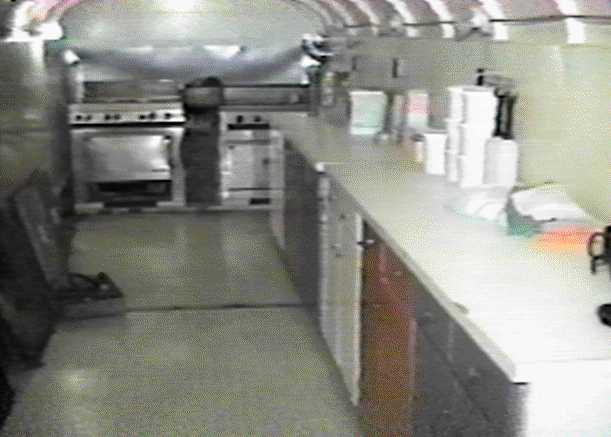 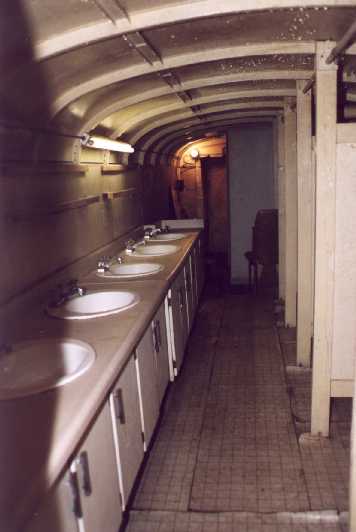
See the layout drawing of the Ark II community shelter
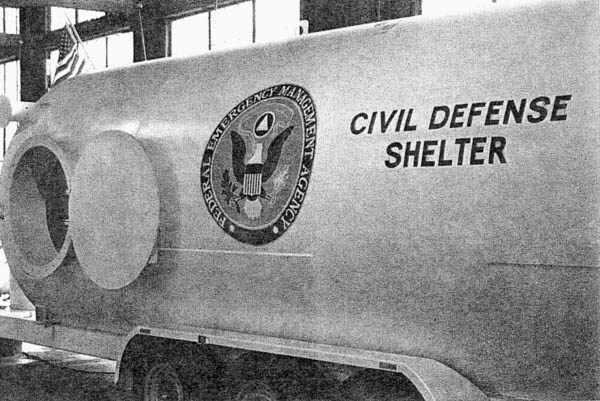
here Ready-To-Bury Blast & Fallout Shelters - Premier: One premier fallout shelter manufacturer in the U.S. today is Utah Shelter Systems. They are steel culvert construction, 8-10' foot diameter and 30-50' long. Complete units start at $75,000 with approximately a six-month waiting period. Options include state-of-the-art chem/bio/nuke filter ventilation, water, sanitation, lighting and other support systems to fully outfit it for long term use.
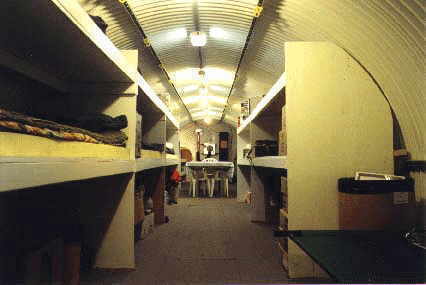
Ready-To-Bury Blast & Fallout Shelters - Premier:
Ready-To-Bury Blast & Fallout Shelters - Premier, Expensive: High quality state-of-the-art, though expensive, shelters are available from Radius Engineering. They are paraboloid shelters constructed of structural fiberglass manufactured to underground storage tank standards. Numerous different models available and the nuclear bomb blast/fallout capable units start at over $100,000 before accessories. Options include state-of-the-art chem/bio/nuke filter ventilation, water, sanitation, lighting and other support systems to fully outfit it for long term use.
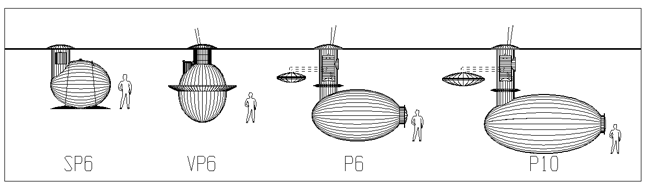
We've still got, as of 8/5/2010, one used, though like-new, Radius P-10 for-sale here at half the price of new and no waiting months to get one! (Also, you'll see there the Carib 'Survival Island' for-sale from an ex-CIA friend of ours, too!)
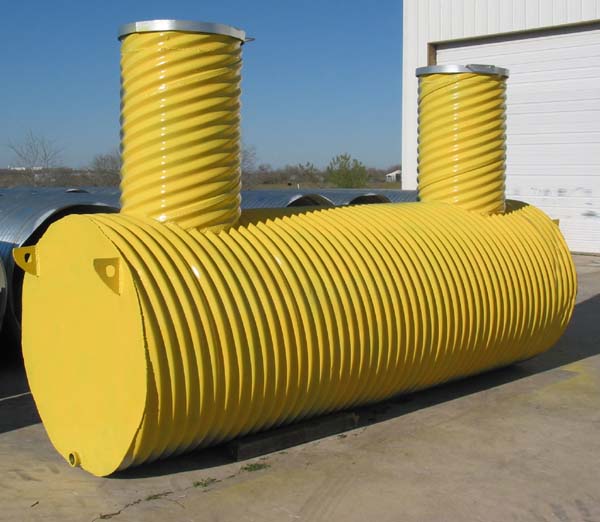
Ready-To-Bury Bomb Blast & Fallout Shelters - Inexpensive: This is the same pre-built ready-to-bury completed Mini Blast & Fallout Shelter designed by the Oregon Institute of Science and Medicine listed above. Fabricated here at KI4U, Inc., utilizing galvanized corrugated steel (14 gauge rated for under road use type) of 4' diameter and 12' long with 3' high double entry/exit risers with double welded (inside & outside) 10 gauge steel plate bulkheads and 1/4" steel blast doors. With this pre-built, pickup truck delivered, shelter and less than two hours of backhoe work later it's in-place in (beneath) your backyard. $3,200.00 FOB Central Texas, call (830) 672-8734 for more information and availability. We try to keep a dozen in inventory here.
In Summary: Your first indication of an initial nuclear detonation may be with their characteristic bright flash. The first effects you may have to deal with before radiation, depending on your proximity to it, are blast and thermal pulse. Promptly employing the old "Duck & Cover" strategy could save many from avoidable flying debris injuries and also minimize thermal burns. Think tornado strength wind destruction descending upon you as you quickly dive behind any solid object or into any available depression. A 500 KT bomb blast, 2.2 miles away, will be arriving about 8 seconds after the detonation flash with a blast that'll last about three seconds. An even larger 1 MT bomb blast, but 5 miles away, would arrive in about 20 seconds, though it's very unlikely many reading this will ever see that large of a nuke ever used. Teach all your loved one's how to survive, too. The majority of people that will be affected, will be downwind of ground zero, some perhaps hundreds of miles away, and will need only protection from the radioactive fallout that will be coming later. If you had pre-planned to shelter-in-place, instead of evacuating long before, you need to be ready for anything anytime. First, besides a home fallout shelter, or at least everything in-place to quickly make it so, you should become aware of other potential sheltering options in your area and along regularly traveled routes. You never know exactly where you'll be when the music stops. You need to also have with you in your car a backpack of essentials to hold you over for at least 72 hours, if need be, while away from home. Tunnels, subways, caves, culverts and especially heavily constructed buildings, all deserve a mental note as you travel by them daily. In the case of existing buildings, below ground basements give the best protection. With some forethought, you can then be ready wherever you are to head to shelter. The important thing to remember is to get yourself quickly where there is as much mass and distance between you and where the fallout radiation will be later settling to then safely allow sufficient time to pass for the radiation to die down to a tolerable level. Teach all your loved one's how to survive, too. Think what you might could accomplish, if you started now well before any nuclear emergency, to explore your available options and built (or at least acquired the materials for) a mass encased small fallout shelter in, or near, your home that could be quickly thrown together. Or, a combination tornado/fallout shelter in the backyard. With 30" of earth covering alone you would achieve a PF of 300 and occupants would be receiving less than 1/300th of the gamma-ray dose of fallout radiation that they would otherwise have received out in the open. Three feet of earth and you'd have it down to only 1/1000th. Also, you need to give some serious thought to afterwards, when your family has survived the bomb blast and radiation. If you are fortunate enough to be reading this well before a nuclear threat (or other major disaster) occurs or appears imminent, there's a great deal more that you can and should do beyond the scope of this brief guide. Surviving the initial threats of a nuclear 'event' and radioactive fallout is relatively easy with the proper knowledge and even the most modest of preparations, as we've detailed above. The ongoing bigger challenge next, though, will be the one brought on by the extensive and much longer-lasting disruptions of services after you survive the nuclear event and emerge safely once the fallout threat has diminished. You might have to go so time with little or no new food supplies, along with disruptions of water, sewer, gas, electric, and telephone services, little or no gasoline, and severely limited, or non-existent, medical and banking services, law enforcement and fire protection. We'd recently expanded What To Do If A Nuclear Disaster Is Imminent! by two more pages to include prepping for afterwards. If you had not read it lately, it's important to do so. Bottom Line: Buy a shelter, build a shelter, or have everything in-place to make an expedient home shelter, it doesn't matter, just get started doing it - NOW! Call it a tornado or earthquake or hurricane shelter, or safe room, root/wine cellar, walk-in storage locker, whatever, but know when the "We interrupt this program for a Special Bulletin..." comes across the TV or radio and your family looks up to you, you will be prepared for the worst and survive it. To best avoid unhealthy and overwhelming angst trying to prepare for a future nuclear crisis, keep in mind, too, that each step is like acquiring medical insurance. We all hope and pray we won't need that insurance, but if we ever do, our families won't find us then lacking in providing for their basic safety and welfare. Once you've started making these preparations, strive to stay balanced about it all as you do. Thank God that you have begun, try to awaken others by first pointing them to The Good News About Nuclear Destruction!, and then you can begin to confidently relax in your new alert status. You'll also then be able to more fully enjoy everyday life with your own family knowing that you're firmly on the road to better being able to handle just about anything that might occur in this quickly changing world.
"A prudent man foresees the difficulties ahead and prepares for them;
Be Sure to Also Check Out Our...
Comments or Suggestions for additional resources to add here:
KI4U, Inc.
© www.NukAlert.com 2003, 2004, 2005, 2006, 2007, 2008, 2009, 2010, 2011, 2012, 2013, 2014. All Rights Reserved.
| |||||||||||||||||||